Social media has made video shorter, but not easier to edit. A 30-second clip may need to establish context, create tension, deliver an idea, and earn enough attention to survive the next swipe — all before a longer format would have finished its introduction. That is why video editing for social platforms has developed into its own discipline. A strong video editor is not reducing long footage to a smaller file; the job is to rebuild the material around how people actually watch on Reels, Shorts, and TikTok.
For brands, creators, and agencies, the difference matters. Social platforms reward speed of understanding, not simply speed of cuts. A good edit makes the idea clear sooner, removes what weakens it, and gives the viewer enough visual information to stay oriented without turning every second into an effect.
That balance is what separates content that looks “edited” from content that feels native to the feed.
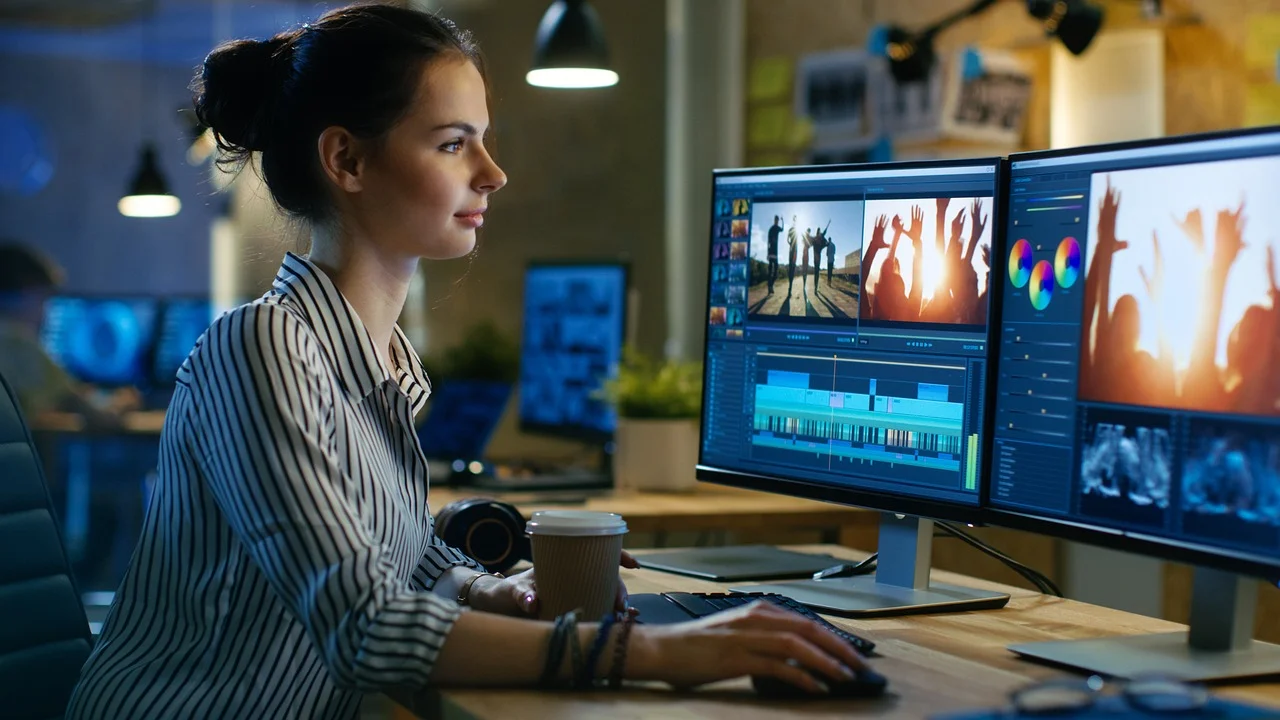
What a Social Media Video Editor Is Really Editing
The obvious answer is footage. In practice, a video editor is editing attention.
A long-form interview can spend 40 seconds building toward a useful point. In a short-form video, those 40 seconds may contain the part that needs to disappear. The strongest line might sit in the middle of the answer, while the context needed to understand it may need to be rewritten visually through captions, B-roll, or a new opening.
That is why repurposing video content rarely works as a mechanical cutdown.
The editor may need to:
- move the payoff before the setup;
- remove repetition without making speech feel unnatural;
- restructure a thought so it works without the original conversation around it;
- reframe horizontal footage for vertical video;
- build captions around meaning rather than transcription alone;
- add B-roll where it clarifies context;
- use motion graphics when information needs visual support;
- adjust pacing for the platform rather than the source recording.
The finished clip may be 20 seconds long, but the useful work happened in the decisions behind those 20 seconds.
That is also why the best social edit often looks deceptively simple. If every visual device is doing its job, the viewer notices the idea before noticing the editing.
Vertical Video Has Its Own Visual Grammar
A vertical video is not a horizontal frame with the sides removed.
The composition changes. Faces occupy more of the screen. Captions compete with platform UI. B-roll has less horizontal space to communicate context. A two-person shot that works perfectly on YouTube may become unreadable at 9:16.
The video editor therefore has to make choices that begin with the platform itself.
Text hierarchy matters more. Safe zones matter more. Framing changes more often. The opening needs to establish the subject quickly enough that the viewer does not spend the first seconds figuring out what they are watching.
The same clip may also need different treatment for Reels and TikTok. The core idea can stay the same, while the opening, caption style, CTA, or pace changes.
This is one reason short-form vertical videos benefit from a defined visual system: typography, caption rules, colors, graphic elements, and recurring layouts can stay consistent, while pacing and storytelling remain flexible.
Consistency should come from brand language, not from using the same editing trick in every clip.
Good Social Video Editing Is More Selective Than Busy
One of the easiest ways to make a social clip feel amateur is to overproduce it.
Extra zooms do not create energy by themselves. Animated captions do not make a weak point more interesting. B-roll cannot compensate for an unclear idea.
The strongest editing skills often show up in restraint.
A video editor needs to know whether a pause creates tension or wastes time. Whether a cut should land on a word, a reaction, or not happen at all. Whether a visual insert adds context or distracts from the speaker.
This applies to graphic design and other multimedia elements as well. They should make information easier to process, not prove that the editor has access to effects.
The same principle applies to professional video for brands. Social content can be polished without looking like a television commercial squeezed into a phone screen. Too much polish may create distance; too little can weaken credibility.
The right level depends on the brand, the platform, and what the content is trying to achieve.
From Raw Footage to Social Content: Where Post-Production Adds Value
The most valuable social workflows start before the first edit is exported.
An interview, podcast, webinar, product shoot, or event may contain far more usable social media content than the original deliverable suggests. The challenge is finding the pieces that can stand on their own.
A strong post-production process reviews raw footage with distribution in mind.
One recording can potentially become:
1) a full youtube and social version;
2) several educational cutdowns;
3) a reaction-led TikTok;
4) a quote-driven reel;
5) a teaser built around a question;
6) a set of clips with different hooks for testing.
The important part is not producing more versions for the sake of volume. It is recognizing that each output needs a reason to exist.
A Remote Video Editor Works Best Inside a Clear System
Creative work no longer depends on everyone sitting in the same room. A remote video editor can work closely with a brand or agency across countries and time zones, provided the production system carries the context.
The weak version of remote video collaboration is familiar: files arrive with a vague message, the editor makes assumptions, feedback comes back as scattered comments, and the next project starts from zero.
The stronger version looks very different.
A mature remote video editing workflow usually includes:
- organized assets and naming conventions;
- a clear brief;
- brand references;
- examples of approved work;
- one place for feedback;
- defined revision stages;
- predictable deadlines;
- ownership of final quality control.
Under those conditions, remote work becomes almost invisible. The client is not managing geography; they are managing a process.
This is also why a fully remote production team can support demanding output. A remote position does not have to mean disconnected work. In many cases, structured asynchronous collaboration is more efficient than constant meetings.
For editors, the ability to work from home or work anywhere is only one part of the equation. The more important question is whether the workflow gives enough information to make good creative decisions.
Freelance Video Editor or Editing Team?
A freelance video editor can be the right choice for a clear project with manageable volume. Direct communication is fast, the structure is simple, and an experienced freelance specialist can become a valuable long-term collaborator.
The limitations usually appear through scale rather than quality.
One social media manager may suddenly need 12 clips instead of four. A campaign creates new deliverables while another batch is still in progress. Different clients need different brand systems. Deadlines overlap.
At that point, the question changes from “Can this person edit well?” to “Can this production model absorb the workload?”
A solo freelance setup and an editing team solve different problems.
A team can distribute work, maintain backup capacity, retain project knowledge, and add quality control without forcing the client to coordinate several individual editors.
E.V.Editor is structured around that kind of ongoing work. The value is not that several people can touch one timeline. It is that recurring production does not depend entirely on the availability of one person.
For agencies, creators, and businesses publishing continuously, that predictability can become more important than the difference between two individual portfolios.
Social Media Editing Is Part of Video Production, Not the Final Cleanup
Social editing is often treated as the last step: record first, then figure out what to post.
That approach leaves value on the table.
When video production is planned with distribution in mind, the shoot itself can support several outputs. Interview questions can produce self-contained answers. Camera framing can leave room for vertical crops. Product shots can double as B-roll. A video producer can capture transitions, details, and reaction shots that later give editors more options.
This matters because the video editor cannot invent coverage that was never recorded.
The same principle applies to very different formats. A product interview, a podcast, or even a wedding video may all contain moments that can work independently if the material was captured with enough flexibility.
The better the production and editing stages understand each other, the less time gets spent repairing avoidable problems later.
Video Editor Jobs and the Shift Toward Remote Post-Production
The growth of searches around video editor jobs, video editing jobs, remote video editing jobs, and remote video editor jobs reflects a broader change in the industry: post-production talent no longer needs to be geographically tied to the client.
There are more remote video editor positions, more remote contract work, and more companies hiring outside their local market.
But technical proficiency is only the entry requirement.
Someone applying for a remote job may know Adobe Premiere Pro, DaVinci Resolve, or other video editing software extremely well and still struggle with social-first editing if they do not understand pacing, platform behavior, feedback systems, or brand consistency.
The same applies to a senior video specialist or someone searching for part time video work. Software experience does not automatically translate into good editorial judgment.
For jobs hiring in social post-production, the strongest candidates usually combine technical execution with an understanding of audience behavior and repeatable production.
The best remote setups give that talent enough structure to perform consistently.
What to Look for in a Social Media Video Editor
A portfolio shows taste. It does not show the entire working relationship.
When evaluating a video editor, look beyond visual polish.
Can they explain why an opening is weak? Can they adapt one idea across several platforms without making every version identical? Can they work inside a brand system without becoming formulaic? Can they handle recurring deadlines and changing volume?
A strong editor should also be comfortable challenging the material.
If the strongest moment is buried at minute 14, the edit should not preserve the original order out of habit. If a caption makes the message harder to read, it should be simplified. If the clip does not contain enough context to work alone, the editor should recognize that before spending time decorating it.
That level of judgment is more valuable than knowing another shortcut in editing software.
For brands producing content regularly, the video editor becomes part of the communication process. The role is not only technical execution; it is protecting clarity, rhythm, and consistency across a growing library of content.
When a Remote Video Editor Becomes a Post-Production Partner
The distinction is usually visible in how much the client needs to manage.
A task-based editor waits for instructions.
A stronger post-production partner learns the system: what gets approved quickly, which formats perform best for the brand, what visual choices are non-negotiable, which feedback repeats, and how source material is usually repurposed.
Over time, fewer things need to be explained.
That is where the economics of a recurring editing relationship change. The value is no longer measured only in how fast someone can finish one clip. It is measured in how reliably the whole content pipeline moves.
For E.V.Editor, that is the more useful role to occupy. Not another pair of hands inside the timeline, but a structured editing layer that helps clients keep social content moving without turning post-production into another internal management job.
Final Thoughts
Social media editing works best when the process starts with the idea, not the effect.
A strong video editor understands how to compress context, protect the strongest moment, adapt the material to the platform, and keep the final piece visually consistent without making it predictable.
For occasional content, a skilled freelance editor may be exactly what is needed. For regular publishing, the bigger advantage often comes from a post-production system that can maintain quality, absorb volume, and learn the brand over time.
That is ultimately what good video editing services for social media should provide: not more edits for the sake of output, but a more reliable way to turn source material into content worth stopping for.